
顶级厨师
How can enterprises embrace AI transformation? ‘5A Framework’ unveiled_我的网站

一 |
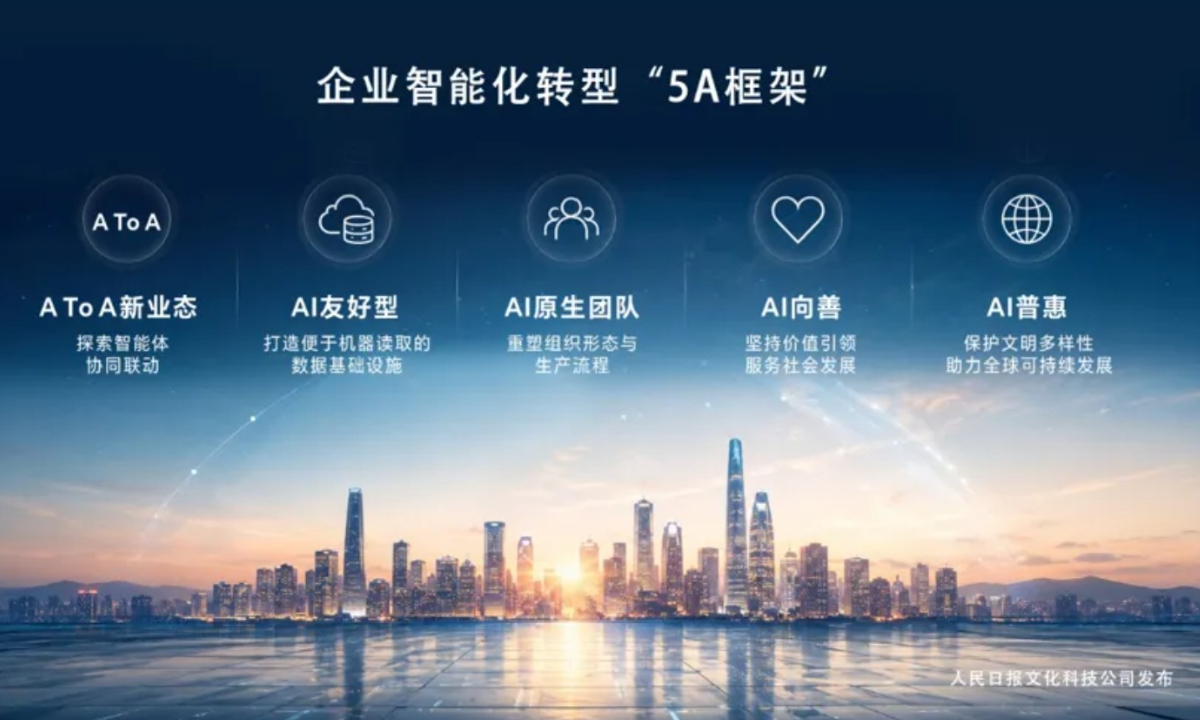
The 2026 Digital Intelligent Economy Forum was held in Langfang, North China’s Hebei Province, on Wednesday. At the forum, organizer People's Daily Cultural Technology Corporation unveiled a “5A Framework” for enterprise intelligent transformation, aimed at helping businesses comprehensively innovate their business models, organizational structures and service systems in the artificial intelligence (AI) era.
A To A: Exploring new models for agent collaboration
AI is pushing the internet into a new stage characterized by the widespread participation of AI agents. In the future, China could develop an ecosystem comprising tens of billions of agent applications, while the global “digital population” could reach hundreds of billions. Following To B (business-oriented) and To C (consumer-oriented) models, enterprises and institutions should actively explore the emerging To A (agent-oriented) model. To enable better interaction and coordination among agents, unified data, technology, interface and service standards need to be established, while new business systems and service models should be cultivated.
AI-friendly: Building machine-readable data infrastructure
Today’s internet user interfaces are primarily designed for human browsing. The first step, therefore, should be to build an “AI-friendly” data system that is better suited to being read, understood and accessed by AI. By structuring content resources and turning them into organized knowledge, while strengthening ontology systems and knowledge graphs, such a system can improve AI’s ability to understand and apply information. On this basis, integrated hardware and software infrastructure combining computing architecture with data systems can be developed for AI applications.
AI-native teams: Reshaping organizations and workflows
AI is profoundly reshaping organizational structures and ways of working. AI-native teams should redefine job responsibilities, organizational structures and business processes around the A-To-A model and AI-friendly services, enabling “everyone to have multiple AI agents.” Professional capabilities and business experience can be encapsulated into “digital employees,” promoting autonomous learning by agents, multi-agent collaboration and the evolution of collective intelligence, thereby multiplying per-capita productivity.
AI for good: Putting values first, serving social development
AI also requires values-based guidance. Guided by the principle of “being people-centered and using AI for good,” efforts should follow the approach of “governing AI with AI and guiding intelligence with wisdom,” ensuring that AI always serves social development, the public interest and people’s needs. The “Mainstream Values Corpus,” whose development was launched by the People’s Daily in May 2023, has already begun to take shape and has been validated through numerous large-model applications.
Inclusive AI: Protecting cultural diversity, advancing global sustainable development
AI should not become merely “a game for rich countries and rich people,” but should benefit all countries. Efforts should be made to actively participate in global initiatives for inclusive AI, bridge the digital and intelligent divide, and enable more organizations and individuals to share the benefits of development on an equal footing, so that AI can truly become a powerful positive force for improving the well-being of all humanity and advancing human civilization.
This was translated and compiled by the Global Times, based on an article originally published on people.cn on August 12, 2026.
。

二 |

三 | 提起这场比赛的高光时刻,大家首先想到的是韦世豪的凌空抽射,是张玉宁的稳健推射,却很少有人提及王上源在防守端的致命救险。

四 | 比赛上半场,库拉索抓住国足中场衔接的间隙,发起快速反击,两名进攻球员形成二打一局面,直插国足禁区,眼看就要形成单刀破门,就在这千钧一发之际,王上源从斜后方飞速回追,凭借精准的卡位和果断的抢断,干净利落地将球破坏,硬生生浇灭了对手的进攻火焰。这记一防二抢断,看似是一次偶然的精彩防守,实则是王上源全场表现的缩影——冷静、果断、责任心极强。

五 | 作为国足中场的防守核心,他本场的任务就是拦截对手反击、衔接后场与前场,全场他完成4次关键抢断、3次有效拦截,传球成功率高达88%,不仅在防守端筑牢屏障,还多次通过精准长传发起反击,成为国足攻防转换的“中转站”。不同于张玉宁、韦世豪的光芒万丈,王上源的表现始终低调却扎实。他没有华丽的脚下技术,没有惊艳的进球数据,却用每一次跑动、每一次抢断、每一次传球,默默为球队付出。本场比赛,他全程高强度奔跑,覆盖中场各个区域,无论是正面拦截对手的突破,还是回追补位化解险情,都做得无可挑剔,完美诠释了“工兵型中场”的价值。很多球迷调侃,王上源是“国足隐藏的定海神针”,这话一点不假。过去几年,王上源在国家队的表现一直中规中矩,甚至偶尔会被质疑“实力不足”,但本场比赛,他用实际行动证明了自己的价值。尤其是那记关键的一防二,不仅守住了国足的球门,更稳住了全队的心态,为后续张玉宁、韦世豪的进球奠定了基础——如果当时国足先丢球,士气受挫,后续能否打出流畅的反击、拿下胜利,都还是未知数。一场胜利的背后,从来都不只有进球功臣,防守端的英雄同样值得被歌颂。张玉宁、韦世豪的破门,是球队进攻火力的体现;而王上源的防守,是球队稳住胜局的根基。在足球比赛中,有时候一次关键的防守,比一粒进球更有价值,它能改变比赛的走势,能拯救一支球队的心态,王上源本场就做到了这一点。赛后,不少球迷呼吁“为王上源记功”,这份认可实至名归。

六 | 他用低调务实的表现,打破了外界的质疑,也让更多人看到了国足中场的韧性。

七 | 对于邵佳一的国足来说,不仅需要张玉宁、韦世豪这样的进攻利器,更需要王上源这样默默坚守、踏实肯干的防守核心。国足2-0赢球,值得欢呼,但我们更不该忘记王上源这样的“隐形功臣”。他的表现,或许不够耀眼,却足够关键;或许不够惊艳,却足够扎实。

八 | 希望未来的比赛中,王上源能继续保持这份状态,为国足筑牢防守屏障,也希望更多人能看到他的付出,记住这位藏在进球功臣背后的防守英雄。(罗掌柜)
Current article:http://xq92q.jiubengtaibingpengou.pics/dzx/i8x8.html
Published on:11:11:49